Ads

Saturday, 26 October 2019

Mushrooms - Parasol Mushroom (Macrolepiota procera) lookalikes

Parasol Mushroom (Macrolepiota procera):
- a very wide gilled mushroom, white gills
- grows in grassland in middle of the summer
- scaly cap and, importantly, a scaly stem (snake-like skin)
- a nipple like in the center top of the cap
- whitish mycelium at bottom of the stem
- a ring that unusually can go up and down the stem if you moved it.
- overall this mushroom is not recommended for beginners, due to deadly lookalikes

Lepiotoid mushrooms were once all groups in the Lepiota genus, but nowadays they are divided in several genus (Lepiota, Macrolepiota, Cystolepiota, Leucoagaricus, Leucocoprinus and Chlorophyllum). Almost all have white spores, ring and saprobiotic (growing in plant litter, rather than associated with tree roots). Identification of species level is very difficult even for experts.

In general, the lepiotoid mushrooms (of which the parasol mushroom is part of) are poisonous. Never eat small lepiota mushrooms.


Lookalikes:
Shaggy Mushroom (Macrolepiota or Chlorophyllum rhacodes), which can cause tummy trouble in some people, it is very similar to the parasol mushroom, but the stem is not scaly, and the size is smaller.


Chlorophyllum molybdites, false parasol or green spored parasol, it is similar, but again it is without the scally stem (and the gills and spores are pale green in adult specimens, but still white when young). It causes poisoning with severe gastrointestinal upset. It tends to have a much less scaly cap.

Amanitas can look very similar when young, and are deadly! So avoid picking parasols when young. Amanitas have lighter flakes on a darker surface, while Parasols have darker flakes on a ligher surface! Parasols have a central knob and regular scale patterns. Parasols also lack the volva from amanitas but they still have an enlarged base. Both have white spores.

Cystoderma amianthinum, saffron parasol. Also scaly stem, but the overall color is diferent. Much more of a dark yellow, instead of the black-brown snaky pattern from the parasol mushroom.

Lepiota castanea, deadly!, stem without scales and much smaller size (about 3cm wide).


Lepiota brunneoincarnata, deadly dapperling, also deadly, also growing in grass, again much smaller (about 4cm wide), despite the very similar appearance to the parasol mushroom! Stem has less scales. Confusion with the edible fairy ring champignon Marasmius oreades and with the very common Agaricus bisporus.


Disclaimer: this is only intended for educational purposes. Do not eat mushrooms based on the information found here. In general, do not eat mushrooms unless you are 100% sure about its ID.

Saturday, 14 September 2019

The wonders of Mushroom identification

I recently attended an amazing mushroom identification workshop, with a serious mushroom expert, and got excited about the possibility about learning more about mushroom identification.

So armed with a mushroom key, I have learning many things by studying and observing mushrooms in the wild.

Word of caution: I do not eat mushrooms in the wild, as I am a beginner (not an expert). Mushrooms can be considerably harder to identify than plants, and many times a edible mushroom has several deadly very similar lookalikes. So, please do not use this blog as a source of information to identify edible mushrooms. This is just intended for educational purposes.

In future posts, I will be writing about the specifics about identifying certain types and species of mushrooms.

Friday, 2 November 2018

Wader birds

Waders describe a waterbird with long legs that wades along shorelines and mud flats (in estuaries or lakes) in search of food, often with relatively long bills. 

Where I live in the Findhorn Bay (Scotland UK), it's a perfect place to identify waders, especially during winter months. I will just concentrate in the more common wader species in the UK.

Lapwings are one of the iconic wader birds in the UK


The most common waders in our region are the ubiquituous Oystercatchers (usually by the shore). Amongst the gulls, you will find a black-white bird, with red bills, legs and eyes. That's the oystercatcher! They eat mussels and have a characteristic piping call. 

In the mudflats estuaries, large flocks of Dunlin, with their dazzling and agile flight patterns, is a fantastic show to spot. Also very common and of similar size but more dumpy appearance is the Knot, which also forms large flocks. 

In between dunlins, one can spot a few larger wading birds in between them. One of the commonest and largest is the Curlew (distinguishable by having a very long bill curved downwards and a characteristic melancholic "cur-loo" call). They have a brown streaked plumage. They breed in spring inland in damp pastures, meadows and moors. The UK holds a quarter of the global population, and its numbers are declining.

Godwits are another large wader, also with a very long (but straight) bill and long legs. There are two species, bar-tailed and black-tailed, the second one is the most common. The orange-brown plumage in summer is a beautiful sight and is a key distinguishing feature. It has black-white wing-bars easy to see in flight.

Redshanks are another large wader, slightly less than the curlew, with striking red long legs and bills red/black. They are also noisy, make calls often "tu tu tu". They breed in coastal saltmarshes and inland wetlands and meadows. A large part of the UK population is present in Scotland.

In estuaries, one can also hear a characteristic strange-sound bird, which is the Common snipe. The bird is a brown bird, smaller than the bird, and they make their highly characteristic sound as they flap their wings during flight. I find it more difficult to observe snipes in the UK, as when I lived in Iceland I use to see snipes every single day of late spring and summer, just in front of my house there.

At the shoreline (and also in tidal mud flats), one will also see groups of very small whitish birds running back and forth along the wave edges, that's the Sanderling, which only visit us in winter time. They breed only in the Arctic (during summer).

Also along the shoreline, in pebbled beaches, another group of small sized waders is the Ringed plover. Their beautiful plumage is easy to identify. It has a black/white head, with a white ring around the neck, and brown back and cap. And a small black bill. Every time I walk by the beach, they fly away from me a little bit further away, as a small flock. In some parts of the UK shores, they can be present year-round and breed usually by the beach in open ground.

Lapwings have a very characteristic "pee-wit" loud shrill call. This is a easy way to spot them near a grassland or a water body. They breed usually in cultivated land or in places with short grassland. In winter they come to the lowland estuaries and arable land, forming flocks. Their metallic-green plumage and crest is a striking feature. In flight, they have stiff wingbeats. Like most waders, their numbers have greatly declined to changes in land use and farming, and increased numbers of predators. 

Going further inland, one can spot the Golden Plover breeding in moderately high hills in Scotland. They have a characteristic melancholic "puu" call, and you can approach them quietly, as they will stand relatively still. Their plumage is very beautiful, mostly of a golden-brown streaked back, a very dark belly and part of the head, and a white band in between, between the forehead and towards the tail. They fly away fast and powerful and can form small flocks. It was another iconic bird I used to spot every summer in Iceland. They winter further south, in England and other parts of Europe.

Dotterel. Oh, this is another beautiful one, but slightly more elusive. From the family of plovers, dotterels can be observed at the top of the highest Scottish mountains in summer-time during breeding. They have a repetitive plain whistle call, which can be the first sign of a dotterel if you come close to them. They have a brown streaked plumage, a black cap and with a white eye-stripe (supercillium), with rusty orange chest. In winter they fly south.

In a future post, we will talk about grebes and divers, as well as raptors.


Thursday, 7 September 2017

Organic fertilizers for potassium and phosphorus

Ranked by richness

Organic sources for nitrogen
Urine
Cut grass
Nettles
Nitrogen fixing crops

Organic sources for phosphorus
Bird Guano
Fish meal, crab shrimps, shells
Bone meal (or Egg shells)
Granite or phosphorus rock dust
Compost toilet sewage
Worm castings
Mushroom compost
Horse manure
Leaf mold (oak)
Buckwheat
Clover
Hair

Organic sources for potassium
Ash
Hay
Sawdust and wood
Cow manure
Comfrey
Kelp
Rock dust
Fruit skins
Clay

Organic sources for calcium and other micronutrients
Egg shells
Lime
Kelp
Coming in soon

Thursday, 16 February 2017

Biological methods of PEST CONTROL

I have spent years practicing organic gardening and I know how important is companion planting to prevent pests. I have faced common pests like cabbage worms and cabbage white butterflies are prevented by planting thyme, garlic and tagete around. Or slugs, which are disencouraged by garlic and mints too, but most effectively by reducing mulching and their access to sensitive plants.

Spider mites, mildew and aphids are common glasshouse pests, as ventillation is the best prevention against them. I notice that neem may prevent spider mites. But overall, moving plants outdoors is the best solution. The same goes for mildew.

Yarrow, lemon balm, garlic, artemisias are excellent species to include in your garden.

Recently I found onion scarlet lily beetles, potato beetles and squash bugs. They are prevented by planting respectively carrot-family species, ground ivy, and tansy.


Slugs: protect plants with plastic bottle rings or even half-cut plastic bottles, surrounded by sand, ash and/or coffee, removing any mulch, and then surrounding the area with a second plastic slug barrier. You still need to cut grass around to keep slugs under control. Inverted plastic bottles work well with lettuce and with seedlings of pumpkins and zucchini. Mints, garlics and carnation repels them, to some degree. Perhaps fennel. Some suggest spraying with chili. Go slug hunting in early morning or in rainy weather. Use ducks until all slugs are gone (before they start eating your garden). Using chicken tunnels (fenced) around your garden, and they will clean all slugs that could move towards your gardens. I haven´t tried sawdust which is also suggested. Planting in greenhouses is also a good solution. Finally you might avoid sensitive crops like lettuce and carrots, and instead plant more resistant crops like kale or spinach. Plant the sensitive crops in well-sheltered beds.

Slug fences work! But remember to trim grass around them!

Inside the fence, protect plants by using plastic bottles or plastic rings. Be creative! But remember to remove these, when hot weather is forecast.

Cabbage pests: spray compost tea. Plant in polyculture! Plant: garlic-family plants, thyme, sage?, nasturtium?, artemisia and tansy repels them; mustard, radish, tagetes, borage, eucalyptus, sage, mints and dill also potencially good. Carrot family plants attract predatory wasps and zinnias attract ladybugs. Hyssop is a trap crop.

Potato beetles: vetches, ground ivy and tansy repels them. also coriander, flax. Plant early, in raised beds, to allow good growth before plants are defoliated by them, to reduce crop losses. Remove them by hand.

Squash bugs: nasturtium, tagete, and tansy repels, catnip and dill also, radish might work.

Mice and moles: artemisia, garlics, euphorbia, rue, fritilary, bury an inverted bottle (wind noise scares them). Cats are also effective.

Onion scarlet lily beetles: carrot-family plants attract predatory pests as well as catnip or mints, also goldenrod and milkweed, nasturtium (repels them). Remove them by hand. Plant onions in raised beds and well separated from each other, possibly in polyculture.

Scarlet lily beetles attack onions

Corn earworm larvae/moth: geranium, thyme, cosmos. Store corn grain in glass jars, and preferably in duplicate, to avoid losing seed.

Ants: coffee, mints and pennyroyal, lemon skins, sugar mixed with borax (not so ethical and healthy)

Codling moths (fruit trees like apples and pears): nasturtium, chives, lavender (but not so effective). More effective: in winter, clear all fallen fruit. In early spring (15°C), setup moth traps and solar lamps with oil, to capture them (this is just to indicate you that they are there, it does not remove the problem). In late spring, when petals fall, spray fruit with organic bacillus thuringiensis, garlic spray or other organic products, before larvae enters the fruit. Repeat every week for a month, until no more moths are trapped. Alternatively, use nematodes against the catterpillars. Place grease bands around the trunk to prevent creeping catterpillars. Keeping chicken under the trees during winter also works quite good.

Citrus worms: use neem oil

INDOOR PESTS

Aphids: Very frequent indoors. Keep plants healthy and not water-stressed or too much nitrogen. Use good ventillation, washing them (rain or a jet of water or with soapy water). Plant mints, garlic, nasturtiums

Spider mites: devastating pest indoors. Use mostly good ventillation; good watering and rain (Expose plant outdoors if possible). Keep plants healthy and not water-stressed. Plant perhaps neem and coriander/dill. Ensure plants are under bright light, and not water-stressed. If necessary, keep plants in isolation and wash them frequently, immersing them in soapy water.

Mildew: ensure good ventillation, expose plant outdoors if possible.

Gnats (small mosquitos): an indoor pest. Avoid organic matter. Cover with a layer of sand over the soil. Keep soil dry. Use vinegar to attract and drown them. Use oil on surfaces or sticky surfaces. Expose plants outdoors or repot plants in sterile new soil.

Root rot: use fine organic matter, use peat, use sterile soil, avoid irregular watering or too moist, do not add too much sand or clay to the soil mix. Keep plants healthy and under good light.

LARGE ANIMALS

Deer: Use fencing, both high and with vegetation. Setup obstacles. Protect young trees. Plant sensitive crops further away from the edges of property. Floating row cover. Spread hair around crops (this might work against other pests too). Some suggest hanging scented soap bars. Another method might involve placing rottening eggs or spraying eggs diluted in water over your crops. If necessary, setup electric fences.

Wild boar: Dogs can provide some prevention. Wild boar is probably more of a problem in early spring when wild food is scarse. It can also be a problem with you have, for instance, a monoculture of corn. Setup fences. Setup obstacles like sticks or branches around sensitive crops like root vegetables.

Birds: Floating row cover. Cats are effective control. Protect young seedlings with inverted bottles. Place baloons, cds, scarecrows around the garden (though this might not be as effective as you think). Buy birdbusters (make artificial noise). Nevertheless, in my experience I haven´t had much damaged from birds, as I see them as beneficial against other smaller pests such as slugs.

Rabbits: Setup fences (60cm high). Remove habitat where they could hide and cover from predators like shrubs. Cats and dogs scare them. Garlic, garlic clips or fish emulsion. Plant alfalfa and clover just for them. Floating row cover.

OTHER CLIMATE PROBLEMS
I decided to include a few other gardening problems.

Forest fires: plant rows of cypress or poplars, at angle, to stir the fire away from your property. Plant ice plant barriers. Clean vegetation in the edges, or setup water lines.

Drought: add a pond. Thick mulching! Beds filled with organic matter or even hugelkultur! Sunken beds. Dense planting. Plant under a tree. Shrub edges to create shade. In desert areas, create an oasis, by creating depressions, swales, and planting desert species like date palms, olives, carobs, mesquites, honey locust and acacias.

Frost: Thick mulching, by adding thick insulating layers of leaves, grass, straw and peatmoss. This way, one can insulate down to -15°C. Use plastic wrapfoam during minor freezes (with straw inside). This can even protect small trees. Use fleece covers during minor frosts.

Cool summers: Plant against a south-oriented wall. Raised beds sloped towards south. Sandy soil, with plenty fluffy organic matter (like straw), to warm rapidly. Add some fresh compost to generate warmth. Setup windbreaks! Use well-adapted varieties from cold countries in the Arctic. Start seedlings indoors. The easiest solution is of course to grow under a polytunnel.

Tomato fruit drop-off. Add calcium to the ground. Avoid irregular watering, too wet or too dry. Add compost tea. Reduce dew moisture in morning, by growing them under a polytunnel, in raised beds or in containers. Use locally adapted varieties.

Plant around: phacelia, lemon balm, tagete, calendula, broad beans, yarrow, chamomile, valerian, dandelion, nettle, horsetail, mugworts and wormwood, aster-family flowers, clovers and lupins.

Also see my previous post in 2011: http://greenspotpermaculture.blogspot.co.at/2011/05/combating-pests-in-gardening-and.html

Tuesday, 27 December 2016

Guide to how to live moneyless! (in the spirit of Gift Economy and Self-sufficiency)


Inspired in the "Moneyless" book of Mark Boyle, which I really recommend!

Moneyless guide / Gift Economy / Living sustainable / Self-sufficiency

1- LAND
- you can grow even in small places like windowsills (for those in cities; see my posts from 2009)
- renting or borrowing land (for instance a friend or relative) / landshare
- using urban wastelands
- join an existing ecovillage (see gen-ecovillage.org, ic.org and eurotopia book)
- occupying ghost towns (especially if you have a good of friends)
- buy land (which is not a moneyless option)

2- HOME AND SHELTER
- home sitting / boat sitting
- house exchange
- living in house of friends (or borrowed for free)
- squatting
- caves
- abandoned blackhouses, farmhouses and ruins
- living in a caravan
- yurts and tipis (or even wild camping)
- natural constructed homes (earthships, strawbale, earthbags, roundhouses, subterranean, benders)

3-  FOOD
- grow your own (the easiest option for most; very easy to grow potatoes, sweet potatoes, pumpkins, corn, kale, onions, turnips, mustard greens, tomatoes, bush beans and amaranth)
- wild food and forage (see eattheweeds.com)
- catch roadkill
- guerrila gardening (especially in cities)
- skipping and dumpster diving (especially in cities)
- community orchards and gardens
    GARDENING
    - seed saving and swap (davesgarden.com)
    - swapping produce with friends
    - food forests, perennial vegetables (low maintainance) like berries, wild greens or fruit trees
    - leafcurf (from nettles, ramps, linden, alexanders, groudn elder and charlock)
    - growing eggs, honey and mushrooms
    - permaculture design (permies.com, geofflawtononline.com)
    - start your own compost, fertilizing with liquid comfrey or nettles
    - sheet mulching using dead tree leaves instead of digging, dense growing instead of weeding
    COOKING
    - cooking from scratch / become a vegetarian
    - use simple ingredients / buy in bulk (rice, cereals, vegetables, pulses are very cheap) 

4- WATER AND HYGIENE
- rainwater harvest
- well, boreholes and rivers
- solar shower
  HYGIENE
     - soapwort as natural cleanser (or mock orange or new jersey tea)
     - hyssop as natural deodorant
     - nurture skin with aloe vera
     - clean hair and skin: herbs soaked overnight (sage, yarrow, mint, rosemary)
     - hair cleaner: rye flour and boiled nettles (or rice flour or boiled linseeds)
     - soap: make lye out of rainwater and hardwood ashes, and add fats
     - toothpaste made of fennel seeds, cuddlefish bone, salt or baking soda
     - toothbrush made out of marshmallow roots, liquorice, neem or eucalyptus
     - mouthwash: boiled mint, anise, thyme, rosemary or lavender
     - cleaning your bum: water rising, newspaper, leaves, or even rocks
     - cut your own hair (or ask a friend)
     - cleaning the house: vinegar (make your own apple cider), baking soda, boiled herbs or salt
     - cleaning the dishes: wood ashes /  scrubber: luffa, a ball of dried grass or pine cones
     - wash your clothes: nearby sink or even river; use sun to dry, a mangle or wear them wet!
     - compost WCs (very easy to build) (see also my post in building your own greywater system)

5- TRANSPORTATION
- barefoot or moneyless shoes (made of recycled tires, plastic bags and carpet)
- hitchhiking (hitchwiki.org)
- liftsharing
- biking
- couchsurfing.com and trusting fate (people offering you accomodation)
- wild camping or bushcrafting (see "outdoor survival handbook" by Raw Mear)
- stay4free.com

6- ENERGY
- opensourceecology.org project
- solar charger
   LIGHTING
       - rapeseed oil candles or beeswax (storytelling, singing, games)
   COOKING
       - start a campire (keyhole fire)
       - rocket stove (elbowed flue pipe, 15kg olive cans, insulating material)
       - hay box (slow cooking)
       - earth ovens (for baking) (see "build your own earth oven" by Kiko Denzer)
    HEATING - putting extra jumpers or clothes
       - gas bottle wood burner
       - mansory oven (more complex)
       - solar heater

7- EDUCATION
- homeschooling
- alternative schools (barefoot college, steiner schools, montessori, small school, , sudbury, summerhill) (see "alternative approaches to education, a guide for parents" by Fiona Carme)
- freeskilling groups
- khanacademy.org, coursera.org, instructables.com 
- get a used mobile phone from friends/ get a computer through freecycle, trash or through friends
- use linux, skype, openoffice, hushmail, duckduckgo, truecrypt

8- OTHER TOPICS
     HEALTH AND SEX
      - Localised healthcare (herbalism)
      - Menstruation (mooncup, reusable pads)
      - Natural contraception (withdrawal method, combined with understanding of a woman cycle)
     CLOTHING
      - cloth swapping (see swishing.com), get from friends, go to a second hand shop
      - make your own, mend, knit your own clothes
      - freeshopping
      - make clothes out of hemp or nettles (but this requires skills)
      - pillows, out of reedmaces / duvets, out of wool
      LEISURE
      - make and play an instrument (for example make out of wood logs and roadkill skin)
      - painting (made out of marigolds, blackberries, poppies, clays, charcoal, chalk, rocks) / mushroom paper
      - street parties, games, performances, debate evenings, local groups, sports, movies...

9- CHILD RAISING
- breastfeeding instead of bottles
- no baby food, at six months combine breastfeeding with some cooked food
- get baby clothes from previous parents, friends or relatives
- co-sleeping with the baby (no extra bed)
- diapers (second hand, rewashable) / diaper-free (by understanding the clues of the baby)
- consider skipping non-essential healthcare and vaccinations (inform yourself, at your own risk)

10 - OPPORTUNITIES FOR SMALL INCOME
(but then you will be part of the system and not truly moneyless)
- unemployment benefits
- woofing, volunteering
- organizing workshops, teaching yoga
- making and selling handcrafts in local markets
- giving massages
- selling in ebay
- writting a blog and adding adsense
- writting and selling ebooks
- local garden work
- seasonal jobs (like fruit harvest)

Get rid of your debts! Potencially get rid of your TV or car!

11- PEOPLE LIVING MONEYLESS
- Mark Boyle
- Daniel Suelo
- Peace pilgrim
- Heidemarie Schwermer
- Elf Pavlik
- Tomi Astikainen
- Jurgen Wagner
.... (links to be added)

12- EXTRA RESOURCES:
- Freeconomy groups, Freegle (ilovefreegle.org), Freecycle.org (second hand stuff and toolsharing)
- GIFT CIRCLES and GIFT ECONOMY (information in soon)
- HelpX, Woofing, Volunteering
- LETS and Timebanks
- Swapaskill.com and Localskillswap.com
- Street freecycling (there are a lot of stuff that people put out in the streets for free to take)
- Book Swap (ReaditSwapit.co.uk and Bookmooch.com), booksharing clubs, Bookcrossing
- Papers and pens: inkcap mushrooms; molted wing feather; birch polypores or polyporus squamosus along with a mesh to make the paper / making recycling paper
- (more links to be added in soon)


Monday, 26 September 2016

Millets, a list of different varieties

Foxtail millet (Setaria italica)
Japanese Foxtail millet 02.jpgThis is a millet, very easy to grow, very tolerant of drought and very fast growing (can be grown in 2.5 to 3 months). It tolerates slightly cooler conditions than other millets. Native to east Asia, widely cultivated as fodder and hay; domesticated since old times. Consumed as food only in poor regions of China and India.

Seed is tiny, and with orange hull, difficult to remove! Conflictive reports, apparently some varieties are easy to remove papery husk but it´s not the case with the variety I cultivated.

Quite productive. I harvested 400g/m2 in Austria.
Very beautiful when ripe. Bright-brown seed heads, quite heavy when ripe. Susceptive to molds.
Less than 1 meter high. Can be grown quite densely. High biomass. Can be grown in containers.


Japanese millet or Banyard millet (Echinochloa esculenta)
Japanese barnyard millet.jpgThis is a millet, very easy to grow and very fast (grown in 2.5 to 3.5 months). Grown in the far East as fooder and also as food, now less popular as rice took over its place.

Seeds are also tiny. Light brown hull is very difficult to remove!

Not as productive as foxtail millet, but it will produce lateral seed heads.
Dries very easily after harvesting.
Taller than 1 meter. Can be grown also densely. Can be grown in containers.


Proso millet (Panicum milliaceum)
Panicum miliaceum0.jpgThis millet thrives with warmer conditions than the two former millets, and a slightly longer growing season (about 3-4 months). This is the most widely grown millet in the US, usually just as birdseed but also as common millet. Best protein profile than wheat but poor in lysine. Highly alkaline. Irritant leaves make not the best fodder.

Best flavour but hull is slightly difficult to remove.
Seeds are large, inverted heads with many gold yellow seeds. Quite beautiful.

Moderately productive.
About 1 meter tall. Requires more space in the soil.


Pearl millet (Pennisetum glaucum)

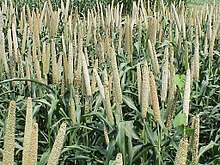
Grain millet, early grain fill, Tifton, 7-3-02.jpgThis millet requires warmer conditions and a bit longer growing season (about 4 months). This is the most widely grown millet in the world, more than 50%. Native to Mali, then spread eastwards to India. A staple in Nigeria and Namibia. Stands harsh soil conditions, including salinity and drought.

Easiest hull to remove! :)
Seeds are large, with a whitish grey color.

Not as productive. Enjoys more watering. Goes dormant in drought.
Taller than 1 meter high. Requires more space in the soil. Sensitive to wind.


Finger millet or Ragi (Eleusine coracana)
Finger millet 3 11-21-02.jpg
Also relatively easy to grow, slower growing (about 4 months).
Adaptable to high altitudes. Native to east Africa and spread to India, where is quite popular and consumed as food. Grows also in the Himalayans.

No information in hull

No information in how productive it is.
Can be smaller than 1 meter. Smal sized plants, quite peculiar the shape of its seed heads.


Kodo millet (Paspalum scrobiculatum)
Image result for kodo milletPrimarily grown in India. Quite drought tolerant but not widely grown. Or only as famine food.

Seeds are very small!
And hulls are very difficult to remove!!

Smaller than 1 meter high.


OTHER MILLETS

Teff (Eragrostis tef)
Extremely tiny seeds, easy to remove husk but due to small sized grains the process is somewhat labour intensive. Harvested within 3-4 months. Very small sized plants, like grass. Plants are very dry tolerant, but require warmth. Native to Ethiopia. Sold sometimes as an expensive new healthy flour.

Sorghum (sorghum bicolor)
A common crop, often used as hay, fodder crop or to produce syrup. Rarely consumed as food. Similar to corn in requirements but more tolerant of dry and poor conditions. Needs warmth and a long growing season.

Fonio millet or Acha (Digitaria exilis and Digitaria iburua)
Native to west Africa and as a famine food. Very small seeds and very difficult to remove husk. Available in two species, white fonio and black fonio (the last is less common). Digitalis compacta, known as Raishan is cultivated in Indochina.


MORE OBSCURE MILLETS

Polish millet or crabgrass (Digitaria sanguinalis)
A common European weed, rarely cultivated as grain, but harvested by hand.

Job´s tears (Coix lacryma-jobi)
Cultivated usually only as ornamental.

Browntop millet or signalgrass (Brachiaria spp. or Urochloa spp)
A common forage grass, usually in the tropics or subtropics. Brachiaria deflexa is known as Guinea millet.


Friday, 12 August 2016

Giant pumpkins! The beasts of our garden!

It´s early August and the garden is thriving.

It has been a very rainy summer, and recently with more cool and even chilly weather.

Nevertheless the giant pumpkins, which have been growing since August, are now of a massive size.
They measure about 1 meter wide and I wonder how heavy they are.

We will have to make a large community pumpkin soup event!

For buying seed, go to http://greenspot.ecrater.com/c/2040221/01-heirloom-vegetables-seeds

This is just one of our giant pumpkins!

The SECRET for getting giant pumpkins is liquid comfrey and plenty of rainfall. But of course the seed counts, the right variety (I sell some of this seed if you are interested)

Now I cut the leaves to stop the pumpkin of growing more and force it to ripe. I don´t want so large fruits!

We have 3 giant pumpkins, coming from two plants.

Overview of our small food forest, with (from left to right) kiwi, beans, corn, amaranth, millets and sunchokes in the background


Tuesday, 26 July 2016

Bountiful gardens in north Austria!

It has been a very thunderstormy summer, with heat mixed with plenty of rain and at times large hail and windgusts. 

We continue our harvest of salads, spinach, kales, turnip greens, radish, and peas, that started in May. Since the beginning of July, we harvest some carrots, swiss chard, and plenty of zucchini and cucumbers. Recently, we began harvesting the first tomatoes, broad beans and bush beans, and ocasionally raspberries. We also harvested our first potatoes and barley. 

In soon we will be harvesting our first pumpkins! In the garden we also have green peppers, runner beans, corn, millets and amaranths, leeks, beets, a few broccoli, sunchokes, chinese artichokes, ocas, mashua, chufas, groundnuts, sweet potatoes and peanuts.

So what has grown fantastically this year and what were the failures? This summer has been prolific for all cucurbits due to the combination of frequent rain and warmth. Other plants grow fast but are also frequently eaten by slugs. Potatoes suffered due to excessive moisture and the Colorado beetle. We had our crop failure with onions, also due to excessive rainfall and the scarlet lily beetle. 

Every week we harvest peas, carrots, plenty of zucchini, cucumbers, and flower for salads. All organic and for free.


We will have a giant pumpkin soup festival in the autumn! Fingers crossed! 
Here is a preview of the largest garden. Watch the height of those jerusalem artichokes on the left edge!

Br growing such massive fast-growing plants locally, we produce our own compost and organic matter. Therefore not depending in external inputs of fertility. Think sustainable!

This week harvest. We can make several meals from this!


And this is one of our two gardens (the small one), which was severely damaged by a large hailstorm last weekend!

The hail stones were insane, as large as eggs! Damage here was large (not just gardens but cars, trees and houses), but thankfully our largest gardens, a few kms away, were left untouched.

Diversity is key.

Lemon cucumber. Looks like a lemon, Tastes like a cucumber!

If you are interested in seeds of any of things we grow, please feel free to buy them from me at www.greenspot.ecrator.com


And here the gardener is harvesting some barley. Yes, we also grow our own cereal.

This is local economy. Our own locally grown resources, out of thin air, bedrock and soil, sunshine and water. 

Fully Sustainable as there are no external inputs other than my own work, my own seeds, rain and sunshine.

And the surrounding countryside and moutains...

Wednesday, 6 July 2016

What can you grow in your climate? How much heat does each vegetable requires?


Many of our crops grow accordingly to temperature, some requiring night temperature above a certain limit, in order not to stall in their growth, orders requiring the heat of the day to thrive quicker.

Consider global warming, and experiment with growing crops that grow more south than you live.

If you live in such kind of landscape, with cool summers, stick to most leaf and root vegetables (kales, turnips, potatoes, peas and broad beans, salads), barley and perhaps try siberian tomatoes, quinoa and zucchini

  • COOL SUMMERS These crops grow happily with temperatures between 5-15°C - the spring in most temperate climates and arctic summers: peas, broad beans, potatoes, kales, mustard, rocket, pak choi, radish, oats and barley, swedes, turnips, cabbages and broccoli sprout. As the temperature is above 10°C, then try lettuce and spinach, and with a longer growing season: rye, leeks, fennel, parsley, celery, parsley, carrots, onions, kohlrabi, parsnips and beets. 
  • COOL TEMPERATE CLIMATES Crops that do not need very warm summers and tolerate cool evenings (10 to 20°C) - this includes most of the UK, Scandinavia, perhaps a warm summer in Iceland: wheat, quinoa, zucchini and siberian tomatoes! If the summer temperatures reaches >20°C, then try corn and rocoto peppers. This climate also allows to grow apple and cherry trees. See my past posts in Icelandic gardening.
If you live in a temperate climate, like most of Europe and North America, then you can grow pumpkins, beans, corn, wheat, millets, amaranth and even try peppers and sweet potatoes. You can also try figs and almond trees.
  • TEMPERATE CLIMATES Crops that need warm summers (28-30°C) but they tolerate cool evenings around 10°C - this is the climate of most continental Europe and North America, and the warmer regions of UK: pumpkins, most types of beans, runner beans, amaranth, foxtail and japanese millet, rocoto pepper, and corn. Many more fruit trees grow with this climate, chestnuts and pears.
  • WARM TEMPERATE CLIMATES These crops also grow in a temperate climate with warm summer days (28-30°C), but need milder nights (15°C) - such as France, north Spain, southeast Europe, perhaps the warmer regions of UK and central Europe: peppers, lima beans and sweet potatoes.  Figs (zone 6), Almond (zone 6-7), Pomegranates (zone 6-7), Guava trees (zone 7-8)
In a Mediterranean climate, you can easily grow peppers, eggplant, cucumber, and watermelon (perhaps peanuts and rice). Experiment also with tropical fruits if you have no frosts
  • MEDITERRANEAN CLIMATES Tolerating not-warm evenings (15°C) but require reliable hot summer days (30-35°C) - southeast Europe, Italy, Spain and Portugal: watermelon, pearl and proso millet, cucamelon, sorghum and winged beans. Peanuts, requiring a longer growing season. Olive trees (zone 7-8), Avocado trees (zone 8-9). Carob trees (zone 8-9). Bananas (zone 9)
  • WARM MEDITERRANEAN CLIMATES These crops require warm nights (20°C), even if summers are not too hot (30°C) - coastal and southern regions in Italy, Portugal and Spain, Azores: cucumber, eggplant, rice and okra. Jackfruit, Mango, Papaya trees (in frost free locations). 
In tropical and subtropical climates, you can grow almost everything, and some crops like moringa, coconuts and cacao, can only be grown in such climate
  • SUBTROPICAL CLIMATES Crops that need hot climates, requiring both warm nights (20°C) and hot days (35°C) - such as tropical or subtropical climates (south Spain, south Italy, Canary Islands, Florida, south California): moringa tree, pigeon pea, bitter gourd. Rambutan tree. 
  • TROPICAL CLIMATES Crops that do not tolerate any cool temperatures, prefering year round tropical weather: coconuts, cacao, black pepper, vanilla.


Wednesday, 29 June 2016

Garden in north Austria, update June 2016 - daily harvests and plants thrive!

In our two gardens in north Austria, as of end of June. Photos and written update.

We have a small garden, 2 square meters, where we grow everything from salad, beets, carrots, bush beans, corn, amaranth, millets, kales, onions and broccoli.
In our larger (community) garden, we had to protect against slugs, with plastic fences. Here you see zucchini, and further behind broad beans and potatoes. A small wheat bed to the right.. 
Kale, with corn and amaranth further behind 

Peppers and okra, planted against a tile, to create a microclimate

Two pumpkins, also protected against slugs. And potatoes behind.

Some perennial vegetables: ocas and chufas, surrounded by spinach.

  • Corn is about 40cm tall and beginning to tassel. I grow 4 different varieties
  • Foxtail millet is about 30cm tall. Other millets (pearl, proso, japanese) are about 15cm tall.
  • Amaranths are about 20-40cm tall, and growing fast (three varieties). Quinoa, some seedlings, some 30-50cm tall begin to spike. Barley has been flowering for a month, while wheat (spelt, emmer, kamut) since two weeks.
  • Tomatoes have been flowering. They are about 50cm tall. 
  • Squash begins flowering, and it has a large size 30-100cm wide. Pumpkins are around 1 meter long and began to flower (giant atlantic and hokkaido). Cucumber produced 1 fruit last week, 1 meter tall, others setting buds have 30cm tall (three varieties)
  • Carrot in seedling stage, eaten often by slugs. Beets as large seedlings. Some heirlooms of both. In community garden, these have been harvested.
  • Peas have been producing pods for about 3 weeks (green and purple). Broad beans are just recently flowering, and around 1 meter high.
  • Bean seedlings are around 20cm high (several types: bush beans, french beans, black beans, runner beans). 
  • Spinach flowering, has been harvested for a month. Lettuce has been harvested for 3 weeks, full size begins to bolt, others are still growing. Valerian salad harvested for second week. Kales harvested since two months. Miner lettuce and minutina now of a fine size and start to be harvested.
  • We failed to grow most brassicas due to slugs and temperature extremes. I have sown some broccoli and cabbages, and in one of smaller gardens, we have some 10cm broccoli seedlings.
  • Eggplant and sweet pepper planted flowering at 35cm tall, peanuts at 15cm high. Okra planted while setting pods. Rocoto planted 30cm tall.
  • Lima beans setting pods indoors. Winged bean just growing. Malabar spinach setting seed indoors, while outdoors remains at 20cm high.
  • Potatoes have began flowering. Its a nice thick patch, combined with onions, which has been damaged by lilly scarlet beetle. Sweet potato vines are between 15cm to 1.5 meter, now under plastic cover. 
  • Mashua vine is just around 30cn tall but healthy. One growing indoors, of around 2m tall begin wiltering. Oca plants are bushy around 30cm wide. Yacon planted with 10cm. Groundnut vines 1meter long. One skirret plant of 15cm high. Chufas remain similar to last month, about 10-15cm high.
  • Other perennials: sea beets, scotish lovage, perennial kales, 

Tuesday, 19 April 2016

Self-sufficiency in Austria!! (Garden in north Austria)

Hey!

Now I live in Gmunden, upper Austria (zone 7) and working on a repeat of my self-sufficiency research study.

Having arrived in Austria with my companion, I met this fabulous community garden group of young people, with whom I join forces in growing food and a future food forest.


I wonder how much food can I grow in a small area 40m2.
They kindly borrowed me a piece of land to experiment with this. And we hope to grow some crops like quinoa, millets and amaranth in Austria, besides perennials like rocoto chili pepper, good king henry, oca, skirret, and others!

Exciting times!
Here goes my "simple" plan of annual vegetables, for self-sufficiency:
  • Garlic (60 pieces planted) (estimated yield 365 pieces, one per day, full year) 
  • Pumpkins (2 seelings planted, planned more 5 seedlings) (estimated yield 10-20 pumpkins, two per month, for half a year or more) 
  • Onions (60 pieces planted, in 4m2) (estimated yield 60 onions, one every 3 days, for half a year) 
  • Corn (50 seedlings planted over 3m2) (estimated yield 50 ears, one per week, for half a year) 
  • Potatoes (currently 4m2, planned more 3m2) (estimated yield 2kg/m2), 15kg of potatoes for about half a year 
  • Beans and peas (72 seeds planted over 2m2) (estimated yield 1.5 kg/m2), 3 kg for 30 meals of 100g, twice a week for 3 months (planned more 3m2 of beans), then enough for half a year 
  • Sweet potatoes (area planned 2m2) (estimated yield 1.5kg/m2), 3kg of sweet potatoes for about 4 months 
  • Barley and wheat (planted area 4m2 barley and 2m2 wheat) (estimated yield 0.5kg/m2), 3 kg (two meals a day, for a month) 
  • Quinoa (planted area 3m2) (estimated yield 0.1kg/m2), 300g (about six meals) for a month 
  • Amaranth (planted 3m2) (estimated yield 0.1kg/m2), 300g (about six meals) for a month 
  • Millet (area planned 2m2) (estimated yield 0.2kg/m2), 400g (two meals a week) for a month 
  • Tiger Nuts (to plant 0.5m2, about 40 pieces) (estimated yield 1kg/m2), 500g for a month 
  • Scorzonera, Skirret, Burdock to plant 0.5-1m2 of each (estimated yield 1-2kg/m2 
I hope to experiment with small plots of Salsify, Oca, Ulluco, Yacon, Malabar Spinach, Sea Beets, Miner Lettuce, Groundnut, Buckwheat and possibly Peanuts.

Yeah, it could be peanuts, but slugs are a major challenge in the rainy Austrian summer. Let's see!

More updates in soon!

If you are iterested in buying some of my seeds, please go to http://greenspot.ecrater.com :)


Wednesday, 25 November 2015

The impermanence of a Permaculturist

This year, 2015, has been a year with plenty of life changes.

Earlier in the year, I left Iceland, and the 4 year Icelandic Permaculture project I was developing at the Sólheimar intentional community. The two food forests I had there, were left behind, mostly to nature, without a caretaker. Some species were moved to a friend's property, a permaculture devotee, located in south Iceland, that was also starting a food forest.

Permaculture garden, located in Sólheimar, Iceland (2014)

In spring, I eagerly started a new project - the Permaculture Food Forest at Vale do Carvalho, in Mortágua, central Portugal. I was excited!

Food forest project, located in Mortágua, central Portugal (2015)

The project was going well for the first months, and quickly reached a staggering number of planted edible species of 230, in a short period of time! I worked there full-time and had a large collection of fruit trees, and other permaculture perennial vegetables, besides the common annual vegetables, including grains, millets, amaranths and quinoas, many types of beans and salads, medicinal herbs, Andean root crops, flowers, nuts, etc

In June however, I had a breakup with my partner. I had to abandon the new project, as it was located in my ex's family property. The project only lasted 4 months! Again, it was left to nature, as no one would take care of it in the times to follow.

I moved (again) many species to a friend's property - that lives south of Porto - and there we quickly started together a new food forest project, that already reached a total of 100 species. We call it the Food Forest of Paulo and Benjamim.

The start of a new food forest project, south of Porto, Portugal (2015)

During the summer, my motivation was mostly to travel. I was tired of such dramatic changes. I began searching for a place where I could settle down, buy some land, and meet like-minded people.

As of now, the abovementioned 3 food forests projects remain in spot, but only the last one, has the care of a friend. In the months ahead, I will travel to explore permaculture and community projects worldwide.


Wednesday, 18 November 2015

Permaculture workshop in Vienna, Austria


Last weekend, the Friday 13th November, I did a permaculture workshop for a group of people, located in a new cohousing project, in Vienna, Austria.

The workshop was named "PermaCityCulture"

The workshop flyer...

As a small group of enthusiastic gardeners gathered, I was enthusiastic to talk on how to do permaculture in the city, from urban balconies to raised beds in outdoors gardens.


The workshop started outdoors, in a quite philosophical manner...

 I talked about how to build good soil, in the raised beds of their cohousing project

For about an hour, I talked on using good principles of Permaculture, such as observing and inspiring ourselves from nature, be it in keeping the soil always with a green cover, or growing perennials, as a source of food.
Talking about comfrey, borage and nettles, as soil builders
Afterwards, the evening came, and we all continued with a presentation and a round talk indoors, with a beautiful view over the skyline of Vienna, in a cozy library room.

Vienna, Austria. 
In the end, we all had a good time, and I was offered a delicious dinner!

Sunday, 8 March 2015

An edible food forest in Portugal - "Benjamim garden"

Over the past few months, changed have happened, and I have left the life I had in Iceland and moved back to Portugal.

Much warmer climate, much better possibilities to grow my own food smile emoticon

Five days of work and we have created our swale, raised bed, with about 30 species of edible plants, some aromatic or medicinal, many of them perennial, some are nitrogen fixing trees, some are less known edible roots, plus some species in risk of extinction (part of our conservation work, part of our food forest). Abundance and sustainability!
  • medicinals like angelica, valerian, marshmallow, burdock, comfrey and berberis
  • aromatics like scots lovage, wormwood, wild garlic and calamus root
  • annuals like miners lettuce, siberian kale, chioggia beets, durum wheat and quinoa
  • permaculture trees like leucaena, honey locust, eleagnus, casuarina, date palm or princess tree,
  • endangered species like jubaea chilensis, clianthus puniceus and dendroseris litoralis, 
  • edible perennials like good king henry, yacon, chinese artichokes, skirret, perennial rye and perennial leeks.


Swale and raised bed. Many edible species planted. An edge of garlic and wormwood will deter any pests. Comfrey nearby. Also many nitrogen fixing species. Perennials like good king henry, chinese artichokes, yacon, perennial leeks and perennial rye. Medicinal herbs too. Hopefully abundance will follow

Happy smiles after half of this bed/swale completed. More to follow smile emo
ticon
If you are iterested in buying some of my seeds, please go to http://greenspot.ecrater.com :)